
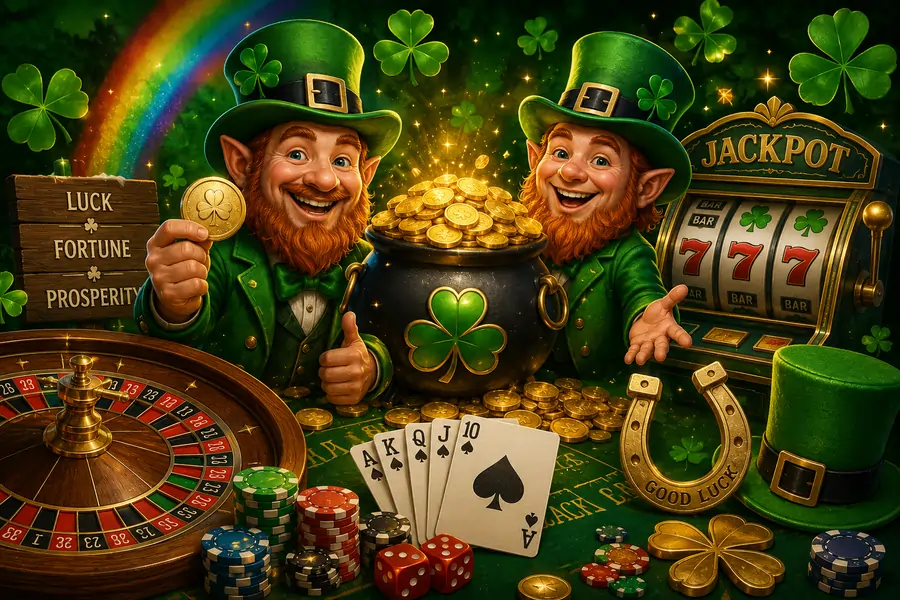
Few cultures have contributed as many enduring symbols of luck to the world as Ireland. The four-leaf clover, the horseshoe, the leprechaun and his legendary pot of gold have travelled far beyond the island that created them, appearing on everything from greetings cards to slot machine reels. Understanding where these symbols come from, and why they have retained such powerful associations with fortune and luck, takes us deep into the rich tradition of Irish folklore that has been passed down through generations of storytellers, monks and poets.
This article explores the mythology behind Ireland’s most famous lucky symbols, traces their journey from ancient Celtic belief into modern popular culture, and examines how they found a natural home in the world of casino gaming, where luck has always been the central theme.
The Leprechaun – Ireland’s Most Famous Keeper of Fortune
The leprechaun is without question the most internationally recognisable figure in Irish folklore. He is a fairy shoemaker, typically depicted as a small bearded man in a green coat, who spends his time hammering shoes and hiding gold. The sound of his cobbling is said to give away his location, and according to legend, if you catch a leprechaun, he must grant you three wishes or reveal the location of his hidden treasure before he can escape.
The origins of the leprechaun stretch back to pre-Christian Ireland and the mythological race known as the Tuatha Dé Danann, the divine beings who were said to have inhabited Ireland before the arrival of the Celts. When the Celts arrived, the Tuatha Dé Danann retreated underground, becoming the fairy folk of later tradition. The leprechaun is thought to be one of these diminished divine beings, retaining his supernatural qualities but reduced in stature and scope to a solitary trickster rather than a god.
The gold he guards is no ordinary treasure. In folklore, leprechaun gold is often described as illusory, disappearing when the captor looks away or transforms into leaves or stones once the leprechaun escapes. This quality of elusive, slippery fortune is central to the mythology and connects the leprechaun directly to wider Irish beliefs about the unpredictable nature of luck. You might glimpse it, you might even reach for it, but it has a tendency to vanish at the critical moment.
The Four-Leaf Clover and the Language of Luck
The shamrock is the most famous plant in Irish culture, associated with Saint Patrick and the Christian concept of the Trinity. But it is the four-leaf clover, a rare mutation of the common shamrock, that carries the stronger association with luck. Finding one is considered exceptionally fortunate, precisely because they are so uncommon. Each leaf is said to carry its own meaning: faith, hope, love and luck.
The belief in the four-leaf clover’s power predates Christianity in Ireland. Celtic druids considered the plant sacred and used it in rituals intended to ward off evil and attract good fortune. When Christianity arrived, the symbolism was absorbed and reinterpreted, but the core belief in the plant’s connection to luck survived. Today the four-leaf clover appears on everything from jewellery to tattoos to the livery of Irish sports teams, maintaining its ancient associations in entirely secular contexts.
In the world of casino gaming, the four-leaf clover is one of the most commonly used symbols precisely because of this deep cultural association with luck. Slot games built around Irish themes, of which there are dozens across every major gaming platform, almost invariably feature the four-leaf clover as a high-value symbol or bonus trigger. The designers of these games are drawing on centuries of belief when they choose that symbol, whether they know it or not.
Irish Mythology and the Casino Connection
The connection between Irish mythology and casino gaming is not accidental. Luck is one of the central themes of both, and Ireland has one of the world’s richest traditions of stories about fortune, fate and the unpredictable generosity of supernatural forces. The leprechaun’s gold, the fairy mounds that grant wishes, the magical wells and sacred trees that bestow blessings on those who find them: these are all expressions of a culture that has thought deeply about the nature of luck and the relationship between humans and fortune.
It is no surprise, then, that casino game developers have returned to Irish mythology again and again for inspiration. Games built around leprechauns, shamrocks, rainbows and pots of gold have been consistently popular since the earliest days of online gaming, and continue to attract players who may have no particular interest in Irish folklore but respond instinctively to the visual language of Irish luck. Casoola Casino is one example of a modern online casino platform that carries a broad range of games, including Irish-themed titles that draw directly on this rich folkloric tradition.
The Horseshoe and Other Lucky Charms
The horseshoe is another symbol with deep roots in Irish and broader Celtic tradition. Iron was believed to have protective properties against fairies and malevolent spirits, and the horseshoe, shaped like a crescent moon and made of iron, combined two sources of protective power. Hung above a door with the ends pointing upward, the horseshoe was said to collect luck and prevent it from running out. Pointing downward, it was believed to pour luck down on those who passed beneath it.
The lucky penny, the wishing well and the magical number seven all appear in Irish folklore and share common ground with the symbols that populate casino games. The wishing well, in particular, has its roots in the sacred wells of pre-Christian Ireland, where offerings were made to water spirits in exchange for blessings. The act of throwing a coin into a fountain and making a wish is a direct descendant of this ancient practice, and the echo of that ritual is present in every coin dropped into a slot machine.
What links all of these symbols is the same underlying belief: that luck is a real force in the world, that it can be attracted and cultivated, and that certain objects, actions and places have the power to tip the balance in your favour. This belief is at the heart of both Irish mythology and casino culture, which is why the two have found such natural common ground.
The Banshee and the Other Side of Fortune
Irish folklore is not exclusively about good luck. The tradition is equally rich in warnings about the unpredictability of fate and the dangers of hubris. The banshee, the wailing spirit who foretells death, is perhaps the most powerful reminder that fortune can turn. She does not cause misfortune; she announces it. The message is that fate cannot always be avoided, no matter how many four-leaf clovers you carry.
The puca, a shapeshifting spirit capable of both helping and harming humans, embodies the trickster quality that runs through much of Irish folklore. Like the leprechaun’s disappearing gold, the puca’s gifts come with conditions attached. What looks like good fortune can reveal itself to be something else entirely depending on how you handle it. This is a sophisticated understanding of luck, one that acknowledges its instability and warns against over-confidence.
These darker elements of Irish folklore carry a message that applies equally well to casino gaming. Luck exists, it can be cultivated and it should be enjoyed, but it is ultimately beyond human control. The wisest characters in Irish mythology are those who accept the gift of good fortune with gratitude and without greed, and who know when to walk away from the pursuit of more.
Irish Lucky Symbols in Modern Casino Design
The visual language of Irish luck is so thoroughly embedded in casino culture that many players encounter it without ever connecting it to its mythological roots. Rainbows ending in pots of gold, spinning shamrocks, grinning leprechauns and sparkling four-leaf clovers are among the most common images in the slot game genre, appearing on platforms from Las Vegas to mobile apps worldwide.
The most successful Irish-themed casino games do more than use the imagery superficially. They create an atmosphere that draws on the warmth, humour and sense of mystery that characterises the best Irish storytelling. The colours are rich greens and golds, the music evokes traditional Irish folk melodies, and the symbols carry layered meanings that players recognise intuitively even without knowing their folkloric origins.
This success reflects the enduring power of the Irish folk tradition. Stories that have been passed down for centuries, refined through generations of telling and retelling, have a resonance that purely commercial imagery cannot manufacture. When a slot game draws on the leprechaun myth, it is borrowing the accumulated weight of a very old story, and that weight is part of what makes the experience feel meaningful rather than arbitrary.
Respecting the Tradition
Irish folklore is a living tradition, not merely a source of commercial imagery. The stories of leprechauns, banshees, selkies and the Tuatha Dé Danann are part of a cultural heritage that continues to be told, studied and celebrated in Ireland and among Irish communities around the world. The best engagement with that tradition, whether in a casino game or in any other context, comes from genuine understanding and respect for the stories rather than surface-level borrowing of the visual symbols.
For anyone who finds themselves drawn to the Irish themes that run through so much of popular casino culture, exploring the actual mythology is richly rewarding. The stories are stranger, more complex and more beautiful than any simplified version can convey, and they have been shaping how people think about luck, fate and fortune for thousands of years. As with all casino gaming, play responsibly and within your means. GamCare offers free and confidential support for anyone who needs it.