
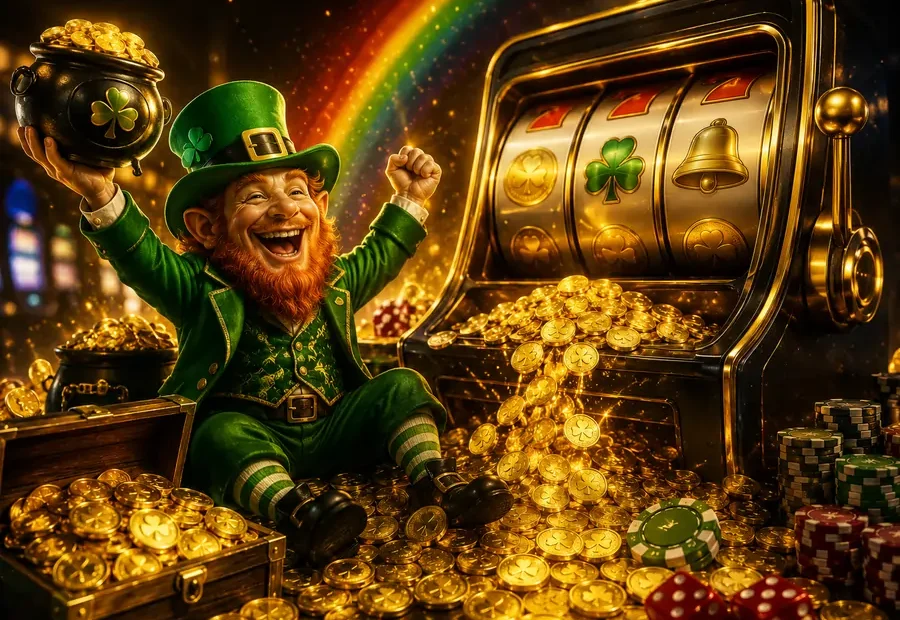
The image of a leprechaun guarding his pot of gold at the end of a rainbow is one of the most recognisable symbols in global popular culture. It appears on greeting cards, tourist merchandise, beer labels and, perhaps more than anywhere else, on the screens of online casino slot games. But the relationship between Irish folklore and casino gaming goes far deeper than a convenient visual shorthand for luck. The mythological traditions of Ireland, with their ancient preoccupations with hidden treasure, supernatural fortune and the capricious nature of fate, map onto the psychology of casino gaming with a precision that no other cultural tradition can quite match. In this article we explore exactly why that connection exists and what it tells us about both Irish mythology and the enduring appeal of casino culture.
The leprechaun as a symbol of hidden wealth
The leprechaun is the most immediately recognisable figure in Irish folklore, but his cultural role is more complex and more interesting than his modern cartoon incarnation suggests. In the original tradition, the leprechaun is a solitary fairy craftsman, typically a shoemaker, who has accumulated a hidden hoard of gold through centuries of careful work. He is elusive, cunning and reluctant to share his wealth, but if you can catch him, he is bound by fairy law to reveal the location of his treasure.
The parallels with casino gaming are immediately apparent. The leprechaun’s gold represents hidden wealth that exists just out of reach, attainable in principle but requiring luck, persistence and the right moment to access. The casino jackpot occupies exactly the same psychological space: it is there, it is real and it could, theoretically, be yours. The pursuit of leprechaun gold and the pursuit of a casino jackpot are driven by the same fundamental human desire, the belief that fortune is hidden somewhere nearby and that the right combination of luck and persistence will reveal it.
Irish mythology’s obsession with treasure and fate
The leprechaun’s gold is just one expression of a much broader preoccupation with hidden treasure and magical fortune that runs throughout Irish mythology. The ancient stories of Ireland are populated with objects of extraordinary power and abundance: the Dagda’s cauldron that never empties, the Lia Fáil stone that cries out when touched by the rightful king, the magical spear of Lugh that guarantees victory in battle. These objects share a common theme: they represent access to something beyond ordinary human experience, a sudden elevation of fortune that transforms the person who possesses them.
This mythological framework creates a cultural predisposition toward the idea that extraordinary fortune is possible, that the universe contains hidden sources of abundance that can be accessed under the right circumstances. It is a worldview that makes casino gaming feel intuitively natural rather than irrational, because the casino jackpot is simply the modern expression of the same ancient hope that animated the myth-makers of early Ireland.
The fairy mounds and the casino floor: parallel worlds of transformation
One of the most powerful recurring elements in Irish mythology is the concept of the fairy mound or sídhe, an underground realm where the rules of ordinary life do not apply. Time moves differently in the fairy world, wealth is abundant and experiences that are impossible in the everyday world become routine. Heroes who enter the fairy mounds may emerge with extraordinary gifts, but they may also lose track of time and return to find that years have passed in what felt like hours.
The casino floor operates on strikingly similar principles. It is a space deliberately designed to suspend normal temporal and financial awareness, where the ordinary rules of everyday life are temporarily set aside in favour of an alternate reality governed by chance and possibility. The carpet, the lighting, the absence of clocks and windows: all of these are architectural choices designed to create the same sense of entering a separate realm that Irish mythology associates with the fairy world. The parallel is not coincidental but reflects a deep structural similarity between the psychological appeal of both spaces.
Luck, fate and the Irish worldview
The concept of luck in Irish cultural tradition is more nuanced and philosophically rich than its popular image suggests. In Irish mythology, luck is not simply random chance but a quality that can be cultivated, inherited and lost. Certain people are described as having luck in the same way they might have physical strength or intelligence: it is a genuine attribute that influences their relationship with fortune. The concept of the lucky person who seems to attract good fortune, and the unlucky person who seems destined for misfortune, runs through Irish folklore with a consistency that reflects a deep cultural belief in the uneven distribution of fortune across humanity.
This mythological framework maps directly onto the psychology of the casino player. The belief that some people are luckier than others, that luck can be cultivated through ritual behaviour and that fortune favours certain individuals at certain times, is one of the most persistent and influential beliefs in casino culture. Irish mythology did not create this psychology, but it gave it one of its most vivid and culturally resonant expressions.
Irish mythology themed slot games: from legend to reel
The influence of Irish folklore on casino game design has produced some of the most enduringly popular slot games in the history of online gaming. Titles built around leprechauns, shamrocks, rainbow treasure and Celtic imagery have dominated the casual casino market for decades, and new entries in this category continue to perform strongly with players across all demographics and geographies.
What makes the best Irish mythology themed slots distinctive is the depth of their cultural engagement. The most successful titles go beyond surface-level imagery to incorporate genuine mythological narrative, creating games where the symbols, bonus mechanics and storylines reflect authentic Irish folkloric traditions rather than generic lucky imagery. Vivaspin Casino features a selection of Irish and Celtic mythology themed games that showcase how the best game designers engage with this rich cultural tradition, creating experiences that are genuinely immersive for players who appreciate the folklore behind the imagery.
The banshee, the pooka and the darker side of Irish luck
Not all Irish folklore is concerned with good fortune. The tradition also contains powerful figures associated with misfortune, warning and the darker aspects of fate. The banshee, whose wail foretells death, and the pooka, a shapeshifting spirit associated with mischief and misfortune, represent the other side of the Irish mythological conception of luck: the recognition that fortune is inherently unstable and that good luck can turn to bad with terrifying speed.
This darker dimension of Irish folklore finds its equivalent in the casino experience in the recognition that luck is not a permanent state but a fluctuating condition that can reverse without warning. The experienced casino player, like the hero of an Irish myth, learns to respect the capriciousness of fortune and to maintain equanimity whether luck is running for or against them. This philosophical dimension, the acceptance of fortune’s instability rather than the naive expectation of permanent good luck, is one of the marks of maturity in both the mythological tradition and the casino experience.
Responsible gaming and the wisdom of Irish folklore
Irish mythology contains a consistent warning about the dangers of becoming too fixated on hidden treasure. Heroes who devote themselves entirely to the pursuit of magical wealth often find that the treasure brings unexpected consequences, and that the pursuit itself has cost them more than the prize was worth. This mythological wisdom has direct application to the casino gaming experience.
Approaching casino gaming with the same perspective that Irish mythology brings to the pursuit of treasure, enjoying the adventure without losing sight of what truly matters, is the foundation of a healthy relationship with online gaming. Set clear limits before each session and treat gaming as entertainment rather than a genuine treasure hunt. For anyone who feels that their gaming is becoming difficult to manage, Problem Gambling Ireland offers free and confidential support for anyone with concerns about their gambling behaviour.
Conclusion
The connection between Irish folklore and casino gaming is not a marketing accident but a reflection of deep structural similarities between two cultural phenomena that are both fundamentally concerned with hidden treasure, the capriciousness of fortune and the human desire to access extraordinary wealth through a combination of luck, persistence and the right moment. Irish mythology gave the world one of its most vivid and resonant frameworks for thinking about luck and fortune, and casino culture has drawn on that framework with remarkable consistency and creativity for generations.