
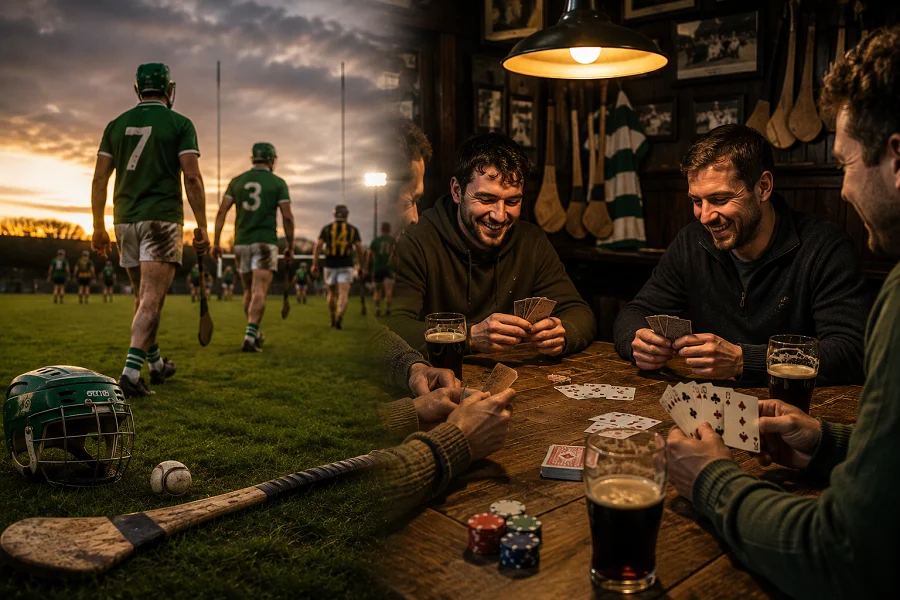
Ask what games define Irish life and most people will immediately think of hurling, the fast, skilful field sport that has been played on this island since long before recorded history began. But Ireland’s game culture runs considerably deeper and wider than the pitch, extending into pub card tables, country roads and children’s autumn pastimes that have quietly survived for generations. This article looks at the games that have genuinely shaped Irish recreational life, from ancient field sports to the card game that carries a surprisingly candid history with gambling itself.
Hurling: the game older than written Irish history
Hurling, known in Irish as iománaíocht, is widely considered the world’s fastest field sport played on grass, and its roots reach back further than almost any other team game still played today. The sport’s first recorded mention dates all the way to 1272 BC, and tradition credits its invention to Celtic warriors, making it a genuine link to pre-Christian Irish culture rather than a modern invention dressed up in old clothes. Two teams of fifteen players, using ash wood sticks called hurleys to strike a small leather ball known as a sliotar, compete across a pitch considerably larger than a standard football field, and the combination of speed, skill and physical courage required has made hurling a genuine point of national pride for centuries.
Gaelic football: a distinctly Irish hybrid
Alongside hurling sits Gaelic football, a sport that blends elements recognisable from both soccer and rugby into something distinctly its own. The dynamic, high-energy style of play has made it one of the most widely followed sports on the island, and like hurling, it carries deep community roots, with local clubs forming the backbone of parish identity in towns and villages across the country.
Road bowling: Ireland’s most rural sporting tradition
Few Irish games are as tied to a specific landscape as road bowling, a sport played not in a stadium but along the actual winding country roads of rural Ireland, particularly in counties Cork and Armagh. The game involves throwing a metal ball, known as a bowl, along a set stretch of public road, with the winner being whoever covers the distance in the fewest throws. This sport’s survival says something genuinely interesting about Irish game culture: rather than requiring purpose-built infrastructure, it simply repurposed the existing rural landscape itself, turning an ordinary country lane into a genuine sporting arena for a single afternoon.
Twenty-Five: the national card game with an unlikely origin story
Away from the pitch and the open road, Ireland’s most enduring indoor game is a card game called Twenty-Five, widely regarded as the country’s national card game. Its ancestry traces back to a Scottish game called Maw, popularised by King James I in the seventeenth century, which evolved through variants including Five and Ten and Spoil Five before Twenty-Five itself emerged as a distinctly Irish descendant. The game’s name draws on a small piece of linguistic wordplay: the Irish word cúig means both “five” and “trick,” giving the game’s key card, the five of trumps, its old nickname of “five fingers.”
A card game with a candid gambling history
What makes Twenty-Five genuinely fascinating from a cultural standpoint is how openly its early history acknowledges gambling. The game was first documented in Ireland in the early nineteenth century, appearing in the Dublin Penny Journal in 1833 within an article specifically criticising rural gambling practices, describing how games of chance were run on a lottery-style basis at country gatherings, with a prize, often a turkey, goose or side of mutton, offered up for a stake far above its real value. Rather than fading into obscurity after this critical introduction, Twenty-Five instead became a staple of Irish recreational culture over the following century, particularly in pub settings, where it remains associated with sociable, low-stakes card nights among friends and family to this day.
Forty-Five: Twenty-Five’s close relative abroad
Twenty-Five’s close cousin, Forty-Five, shares the same Scottish ancestry and Irish evolution, and it found a particularly durable second home overseas. Irish emigration to Atlantic Canada carried the game across the ocean, where it remains popular today, especially on the west coast of New Zealand’s South Island too, a detail that traces the reach of Irish emigrant communities through the card games they carried with them and kept alive in workingmen’s clubs and community halls far from home.
Conkers: the schoolyard game that needs nothing but a tree
Not every Irish game requires a pitch, a road or a deck of cards. Conkers, a children’s game played with horse chestnut seeds threaded onto string and knocked against an opponent’s conker in turn, requires nothing more than a nearby horse chestnut tree and the patience to find a good, hard seed each autumn. Its survival across generations of Irish schoolchildren, despite requiring no purchased equipment and no formal rules beyond what gets negotiated in the schoolyard, says something genuine about which games actually last: the simplest ones, requiring the least infrastructure, often outlive far more organised pastimes.
Why Ireland’s game culture leans so heavily on chance and skill together
Looking across hurling’s split-second skill, road bowling’s precise throw and Twenty-Five’s trick-taking strategy layered over genuine chance, a pattern emerges: Irish games have consistently blended skill with an acceptance of luck’s role, rather than trying to eliminate chance from competition entirely. This same theme runs through Irish mythology, where fate and fortune appear constantly as forces that skilled heroes must work with rather than around, a cultural thread that connects ancient storytelling directly to the card table and the sporting field alike.
From the kitchen table to the modern screen
Twenty-Five’s frank gambling origins, openly criticised in an 1833 newspaper yet still thriving in pubs today, offer a genuinely interesting historical parallel to how card and chance-based games have continued evolving into modern digital form. Where a nineteenth-century Irish gathering might have wagered a goose on a hand of Twenty-Five, today’s equivalent often takes the form of a relaxed session at an online casino such as smash, offering the same blend of card-based skill and chance that has entertained Irish card players for nearly two centuries, just accessed from a phone rather than a pub table.
Games as a thread through Irish community life
What ties hurling, road bowling, Twenty-Five and conkers together is not their format but their function: each one gave, and still gives, Irish communities a shared, low-cost way to gather, compete and pass time together, whether on a parish pitch, a quiet country road or around a kitchen table on a wet evening. This community function matters as much as the games themselves, and it explains why so many of these pastimes have survived largely unchanged for generations despite the arrival of countless newer entertainment options.
Responsible enjoyment of chance-based games today
Whether your game of choice is a hand of Twenty-Five at a family gathering or a modern online casino session, the same sensible principle applies that Irish card players have quietly understood since the nineteenth century: treat the stake as entertainment spending, decided in advance, rather than something to chase once the cards or the reels are not going your way. Set a clear budget and time limit before you begin, and treat any winnings as a pleasant bonus rather than an expectation.
If gaming ever starts to feel difficult to control, free and confidential support is available. Gamblers Anonymous Ireland holds regular meetings across the country and welcomes anyone with questions about their own play.
Conclusion
From hurling’s pre-Christian origins to Twenty-Five’s candidly documented gambling history and conkers’ simple schoolyard survival, the games Irish people play reveal a culture that has always balanced skill against chance and communal gathering against individual pride. These pastimes have proven remarkably durable precisely because they ask so little in the way of infrastructure and so much in the way of genuine, shared enjoyment, whether that takes place on a hurling pitch, a country road, or around a kitchen table with a well-worn deck of cards.