
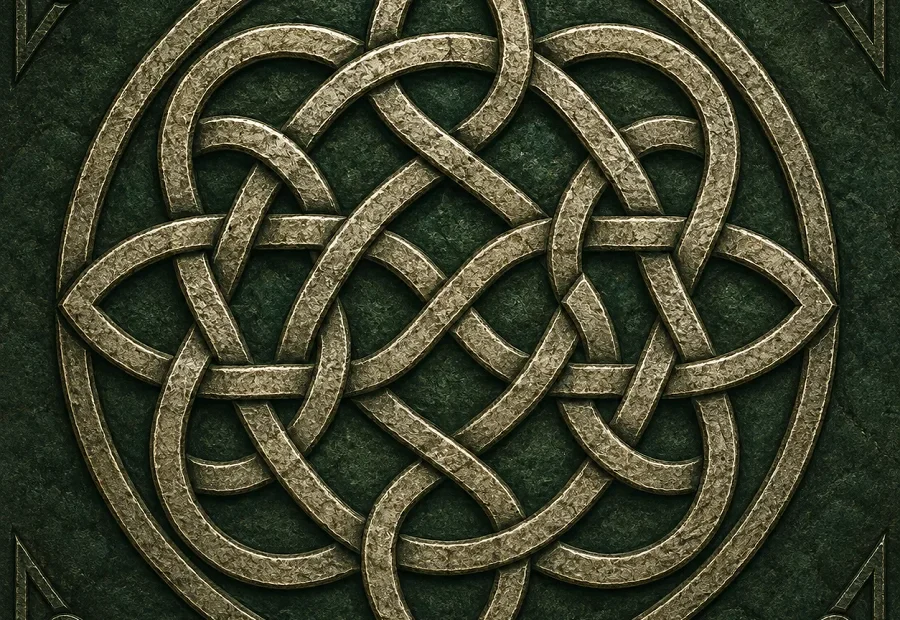
Few images are as instantly recognisable as a Celtic knot, that continuous, interwoven line looping endlessly back on itself with no visible beginning or end. These designs appear on everything from ancient stone crosses to modern wedding rings, and their popularity has only grown since the Celtic Revival of the nineteenth century. But what do these intricate patterns actually mean, and where did they come from? This article traces the history and symbolism behind the most recognisable Celtic knots, from the famous Trinity Knot to lesser-known designs like the Dara Knot and Solomon’s Knot.
What Makes a Knot “Celtic”
Celtic knots are complete loops that have no start or finish, and this unbroken quality is central to their meaning. Depending on the specific design and who is interpreting it, these knots have come to represent eternity, loyalty, faith, friendship or love. Interlacing patterns of this kind have been used in art for centuries, and while their exact origins are often debated by historians, their continued use across Irish and Scottish heritage has made them powerful symbols of Celtic identity right up to the present day.
The Trinity Knot: Ireland’s Most Famous Symbol
The Trinity Knot, also called the Triquetra from the Latin for “three-cornered,” is arguably the best known of all Celtic knots. The design consists of three interlocking arcs formed from one continuous line, with the central arc pointing upward while the other two point downward to either side. The Celts revered the number three, believing that everything of genuine importance came in threes, and for them the Triquetra’s three arcs symbolised the cycle of life, death and rebirth, with the endlessly looping pattern representing eternity itself.
The symbol’s exact origins remain genuinely debated among historians. Some scholars trace it back as far as the Iron Age, with similar three-cornered designs appearing on ceramics from Anatolia and Persia from around the fourth century BC, as well as on runestones across Northern Europe. Regardless of its precise origin, the Trinity Knot became firmly associated with Irish Christian art through its appearance in the Book of Kells, the celebrated ninth-century illuminated manuscript held at Trinity College Dublin. In Christian symbolism, the knot came to represent the Holy Trinity, the Father, Son and Holy Spirit, though its meaning shifts depending on who is reading it: for those drawn to pre-Christian Celtic tradition, it can equally represent the three realms of earth, sea and sky.
The Dara Knot: Strength Rooted in the Oak
The Dara Knot takes its name from the Irish word doire, meaning oak tree, and its intricate, interwoven design is meant to echo the tangled root system of an ancient oak. The oak held particular significance in Celtic culture as a symbol of strength, wisdom and endurance, and this knot was historically used on armour and weaponry precisely because of that association. Unlike the ancient Trinity Knot, the Dara Knot is a more modern design, though it draws directly on genuine Celtic lore and the deep reverence the Celts held for trees as a connection between people, their ancestors and all living things.
The Shield Knot: A Symbol of Protection
The Shield Knot is intimately linked with protection, strength and authority, typically appearing as a circular design divided into four interlocking quadrants connected at a central point, much like the handle of an actual shield. The Celts wore this symbol with genuine pride heading into battle, and it was also displayed near the sick, believed to ward off evil spirits and provide safety and security to those who bore it. Interestingly, the Shield Knot’s origins likely predate the Celts entirely, with some of the earliest known examples found near the Fertile Crescent in what is now the Middle East, long before the symbol became strongly associated with Celtic culture.
The Spiral Knot: One of the Oldest Designs
The Celtic Spiral Knot, also known as the triskele or triskelion, is genuinely one of the oldest Celtic knots still in use, with some examples dating back to around 3,200 BC. Rather than interlacing loops, this design consists of a single continuous line splitting into three separate spirals, commonly understood to represent the three forces of nature, water, fire and earth, or the same life, death and rebirth cycle associated with the Trinity Knot. The gaps within the spirals themselves are said to symbolise these stages, and the symbol was frequently placed on monuments and places of worship due to its spiritual associations.
The Celtic Love Knot and Sailor’s Knot
The Celtic Love Knot represents eternal love, unity and commitment, typically depicted as interlacing lines forming a series of hearts or a continuous unbroken loop. Historians believe love knots were once exchanged between people much the way wedding rings are exchanged today, serving as a token of genuine commitment long before modern engagement traditions existed. The closely related Sailor’s Knot, though simple to actually tie, creates a bond that is genuinely difficult to break, and this practical durability made it a natural symbol of enduring love and friendship, still used today on wedding bands.
Solomon’s Knot: The Lesser-Known Design
Solomon’s Knot is one of the lesser-known Celtic knot patterns today, consisting of two closed loops that are double interlaced, weaving under and over each other with straighter lines and edges than the flowing curves seen in most other Celtic designs. It is genuinely one of the oldest patterns of this kind, with examples dating back to stone age carvings. The name references King Solomon and his association with wisdom and knowledge, and the symbol is thought to represent the intrinsic connection between the physical world and the divine.
Why These Symbols Still Resonate Today
The renewed popularity of Celtic knots, particularly since the nineteenth-century Celtic Revival, reflects something genuine about how people in Ireland, Britain and across the Irish diaspora use these ancient designs to reconnect with their heritage. This connection between symbol and story runs throughout Irish folklore more broadly, where visual motifs and oral tradition have always worked together to carry meaning across generations, each knot pattern functioning as a kind of visual shorthand for ideas that would otherwise take paragraphs to explain.
How to Tell the Different Knots Apart
With so many variations in circulation, distinguishing between Celtic knots becomes considerably easier once you know what to look for. The Trinity Knot’s three simple, rounded arcs are the most immediately recognisable, while the Dara Knot’s denser, more tangled interlace reflects its root-inspired design. The Shield Knot’s circular, four-quadrant structure sets it apart clearly from the others, and the Spiral Knot is unique in using spirals rather than interlaced loops at all. Once you recognise these underlying structural differences, identifying which knot you are looking at, and understanding roughly what it was traditionally meant to represent, becomes considerably more intuitive.
Conclusion
Celtic knots carry centuries, and in some cases millennia, of accumulated meaning within their deceptively simple, continuous lines. From the Trinity Knot’s association with eternity and the Holy Trinity to the Dara Knot’s roots in oak tree symbolism and the Shield Knot’s protective power, each design tells its own distinct story while sharing the same underlying idea: an unbroken line representing something that endures beyond a single moment. Understanding these differences transforms these knots from purely decorative patterns into genuine windows onto centuries of Celtic belief and identity.