
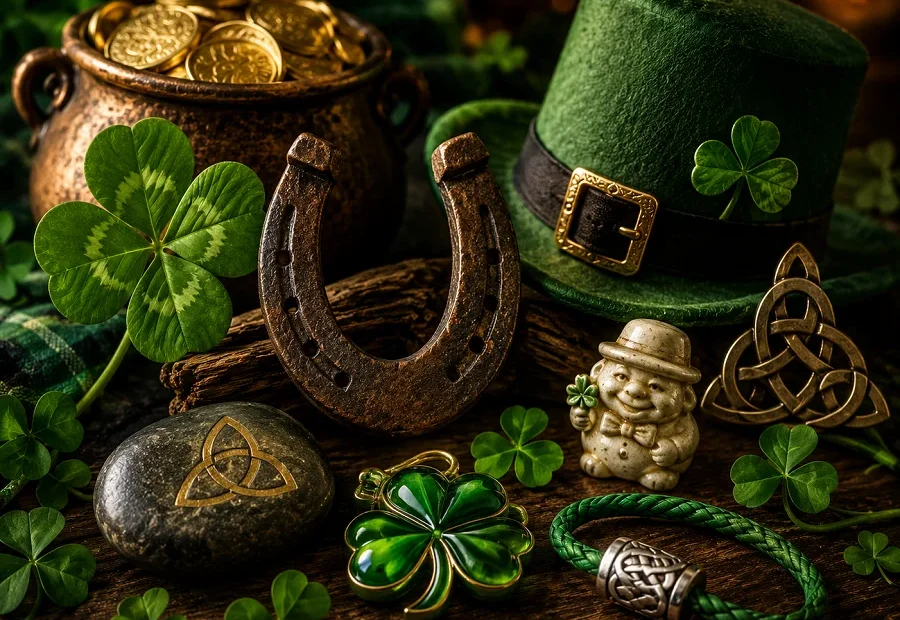
Few countries have exported their symbols of fortune as successfully as Ireland. The shamrock, the four-leaf clover, the leprechaun and his pot of gold, these images circle the globe every March and appear on everything from jewellery to greeting cards. But the actual history behind these symbols is considerably richer and stranger than the simplified versions sold in gift shops, and understanding where they genuinely came from adds real depth to why they still resonate so strongly today, including in the design of modern casino games that borrow this imagery wholesale. This article traces the real history and meaning of Ireland’s most famous luck symbols and looks at how they have found a second life on the reels.
The shamrock: a religious symbol, not originally a lucky one
The shamrock’s fame rests on a story most people know only in outline. According to tradition, Saint Patrick, Ireland’s patron saint, used the three-leafed shamrock to explain the concept of the Holy Trinity, the Father, Son and Holy Spirit, to the pagan Irish he was working to convert during his missionary efforts in the fifth century. This origin is specifically religious rather than about luck at all, and the plant’s deeper cultural resonance in Ireland draws on older Celtic tradition too, where the number three carried significant spiritual weight, representing balance between the physical, mental and spiritual dimensions of life.
What is genuinely interesting is that the shamrock’s association with luck specifically is a later development layered on top of its original religious and cultural meaning. Over time, as the symbol became inseparable from Irish identity itself, it absorbed the broader sense of good fortune that now surrounds everything connected to Ireland, rather than luck being its original purpose.
The four-leaf clover: rarity as the source of luck
The four-leaf clover is often confused with the shamrock, but they are genuinely distinct symbols with different origins. Where the shamrock is specifically the common three-leafed clover tied to Saint Patrick, the four-leaf clover earns its lucky reputation purely through statistical rarity, occurring in roughly one in five thousand clovers depending on the source you consult. Some accounts trace the symbol’s meaning back to Celtic Druidic belief, where each of the four leaves was thought to represent one of the classical elements, earth, water, air and fire, giving the rare find a kind of elemental completeness that ordinary clovers lacked.
This connection between scarcity and value is worth pausing on, because it is precisely the same psychological principle that makes rare combinations in any game of chance feel meaningful. A four-leaf clover is lucky specifically because it is uncommon, and that logic of rarity equalling reward runs directly through to how modern casino games are designed, where rare symbol combinations are deliberately built to feel like a genuine discovery rather than an ordinary outcome.
The leprechaun: a solitary craftsman, not a treasure guardian by nature
The leprechaun’s modern image, a cheerful little man guarding a pot of gold at the end of a rainbow, is a simplified version of a considerably older and more complex figure in Irish folklore. Traditionally, the leprechaun was a solitary fairy shoemaker, a skilled but reclusive craftsman whose wealth came from decades of careful work rather than magical origin. His gold became something to be caught rather than simply found, since folklore held that if you managed to physically capture a leprechaun, fairy law obliged him to reveal the location of his hidden treasure, though his legendary cunning meant he would do everything possible to trick his captor and escape before honouring the bargain.
This detail matters because it reframes the leprechaun’s gold as something earned through vigilance and cleverness rather than pure chance, a more active and skill-based kind of luck than the passive good fortune people often assume the myth represents.
The horseshoe: protection before prosperity
The horseshoe’s role in Irish luck tradition is older and more protective in character than most of the other symbols on this list. Traditionally hung above doorways, the horseshoe was believed to guard homes against malevolent spirits before it became associated more generally with prosperity and good fortune. This protective function connects the horseshoe to a broader category of Irish luck symbols, including the reverence traditionally shown toward fairy forts, ancient earthworks scattered across the Irish landscape that were treated with genuine caution and respect out of belief that disturbing them invited misfortune.
The rainbow: a surprisingly modern addition
Here is a detail that surprises many people encountering Irish folklore in depth for the first time: the rainbow itself, so central to the modern leprechaun image, has little genuine grounding in traditional Irish culture. Folklorists studying Irish oral tradition have noted that Irish people historically held no particular special affinity for the rainbow as a symbol, and its strong association with pots of gold and leprechauns appears to be a considerably later, more commercially driven addition to the mythology, likely popularised through illustration and marketing rather than genuine folk tradition. It is a useful reminder that not every symbol we now consider ancient Irish folklore actually has roots that deep, an insight that becomes clearer the more you explore genuine Irish folklore beyond its commercialised modern packaging.
From folklore to the reels: how these symbols found a second life
Casino game designers discovered decades ago that Irish luck symbols translate almost perfectly to slot machine design, and the reasons are worth understanding rather than taking for granted. Shamrocks, gold coins, leprechauns and horseshoes are instantly recognisable across cultures, require no explanation to communicate their meaning, and carry an existing emotional association with fortune that a brand-new symbol would have to build from scratch. This makes Irish folklore one of the most efficient visual languages available to slot designers anywhere in the world.
The leprechaun’s gold in particular maps almost perfectly onto the structure of a casino jackpot: both represent hidden wealth that exists just out of reach, attainable through the right combination of persistence and fortune. Games built on this imagery draw on centuries of accumulated cultural meaning rather than inventing symbolism from nothing, which partly explains why Irish-themed slots have remained consistently popular across generations of casino gaming, from early mechanical machines through to today’s digital platforms.
Playing with an understanding of the symbolism
Knowing the genuine history behind these symbols adds a layer of appreciation to encountering them in a modern game, much the same way that understanding a painting’s historical context deepens how you look at it in a gallery. You can find a good selection of Irish luck themed slots at betzard casino, and the experience becomes more interesting when you recognise that the shamrock on the reels descends from a fifth-century teaching tool, or that the leprechaun’s gold reflects centuries-old ideas about vigilance and cunning rather than passive good fortune.
Luck as cultural meaning, not literal power
It is worth being clear about what this history does and does not tell us. These symbols carry genuine cultural weight and centuries of accumulated meaning, but none of them have any actual influence over outcomes in a modern casino game, which are governed entirely by certified random number generators regardless of how many shamrocks appear on the reels. Enjoying the symbolism is a matter of cultural appreciation and aesthetic pleasure, not a belief that a lucky symbol changes the underlying odds of any given spin.
Responsible enjoyment of luck-themed games
Games built around luck symbolism can be genuinely enjoyable precisely because of the cultural richness behind the imagery, but the same sensible limits apply here as to any form of casino gaming. Set a clear budget and time limit before you start playing, and treat the experience as entertainment grounded in genuine cultural interest rather than an expectation of the kind of fortune the folklore describes. If gaming ever starts to feel difficult to control, free and confidential support is available. Gamblers Anonymous Ireland holds regular meetings across the country and welcomes anyone with questions about their own play.
Conclusion
Ireland’s most famous luck symbols carry histories considerably richer than their simplified modern versions suggest, from the shamrock’s religious origins to the leprechaun’s reputation as a cunning craftsman rather than a passive treasure guardian, and even the rainbow’s surprisingly recent addition to the mythology. Understanding this genuine history transforms these symbols from decorative shorthand into something with real cultural depth, whether encountered in a folklore archive or on the reels of a modern casino game inspired by centuries of Irish storytelling.